
Service
Podiatry and Chiropody
Podiatry is a branch of healthcare which specialises in conditions and treatments of the foot.
Podiatrists study for a degree qualification and are entitled to use local anaesthetics and some prescription-only-medicines if appropriate to their treatment.
Chiropody is an old-fashioned term that was used to describe how we treat basic skin and nail problems.
Since the mid-1990’s the diploma was replaced with a degree course, that included a much wider range of training, for example woundcare, the effect of diseases on the feet, biomechanics, use of anaesthetics for nail surgery and access to some prescription only medicines.
We are also regulated by the Health and Care Professions Council and have to maintain registration by undertaking regular and varied training.
This registration is how you know we are legitimate.
Sometimes footcare treatments can be available from other providers called Foot Health Practitioners. These practitioners have undergone only a short basic training and are not a regulated healthcare profession.
Professionally, we are supported by the Royal College of Podiatry who provide our clinical standards and treatment guidelines to adhere to. Any breach in either professional standards or clinical standards could lead to being removed from the Council’s register. Therefore, being able to legally use the designation Podiatrist or Chiropodist is testament to our skills and education, and an honour.
Service
Podiatry and Chiropody
Ingrowing Toenail
When a nail has a curved edge, it can easily cause aggravation to the skin alongside it. This situation can very quickly escalate into an ingrowing nail, with bleeding or pus or even extra tissue growing over the nail.
Verrucae/Warts
Verrucae, or warts, can be a persistent and annoying problem because they can take years to disappear or may not at all.
Fungal Nails
Nails that are damaged or thick can be most vulnerable to fungal infections.
Foot Pain
Who wants to be stopped in their tracks by pain?! Do you suffer with pain under the arch or achilles tendon? Maybe a sore bunion or burning sensation under the ball of the foot?
Pain around the feet and ankles can occur for so many reasons and can require investigations into movement and function.
Often musculoskeletal or biomechanical pain will require orthoses to resolve and some rehabilitation work to get you fully fit and back to activity again.
Flat Feet
Having flat feet is not always a problem, but if it is accompanied by pain in the foot, ankle, knee or hip, the foot position can be a sign of a more significant problem.
Forefoot Pain
There are many different causes and sites of forefoot pain, but mostly it arises as a result of overloading the front of the foot.
Heel Pain
Pain under the heel is often a result of tissue injury or overload, but the causes aren’t always clear.
Thickened Nails
Nails are frequently the cause of embarrassment, but they need not be!
Athletes Foot / Tinea
Athlete’s foot is a fungal infection of the skin.
Skincare
Quick diagnosis of problems and effective treatments are key to maintaining the skin’s integrity
Corns and Calluses
Hard, thick skin can become really compacted and form a corn. This is usually described as standing on a stone or a needle.
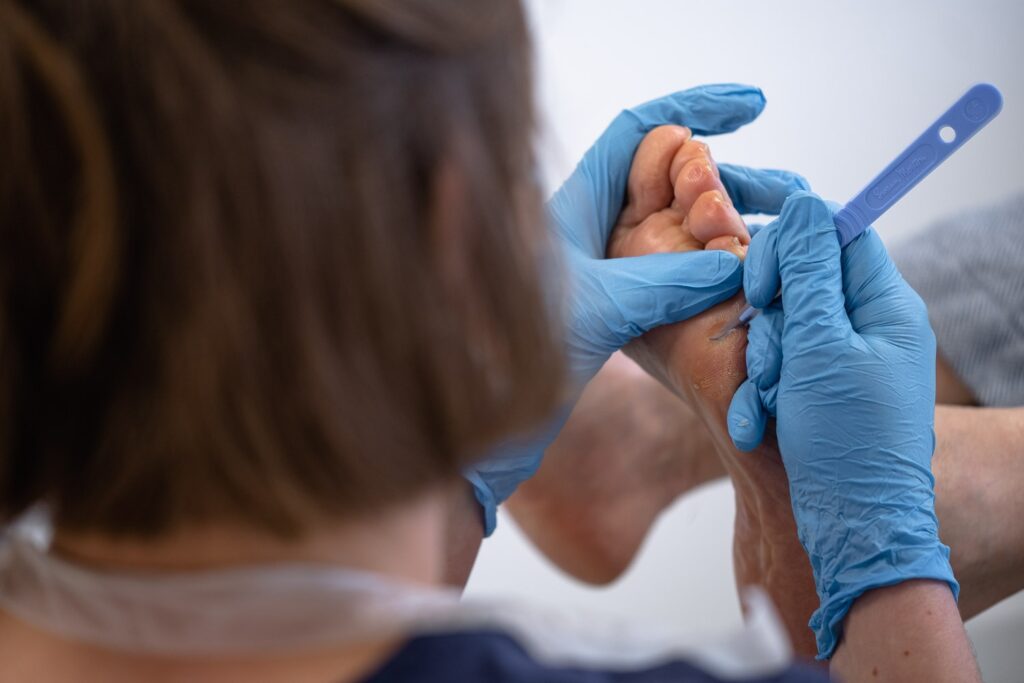
Who would have thought skin could be so painful?! Unfortunately corn plasters and razor blades are not safe methods of corn removal and injuries easily occur! The use of scalpels for corn and callus treatment is something that podiatrist are uniquely trained and experienced in.
A few minutes in the right hands and you will be skipping along again!
Diabetes Footcare
With the feet being so vulnerable to problems it is imperative that they are expertly looked after.
We can help prevent ulcerations and amputations to feet affected by diabetes, because we are experts in foot care.
We can monitor blood flow into the feet and nerve ending function, which are commonly affected, and also keep a keen eye on any vulnerable areas.
We can tell you all the best tips to keep them safe for as long as possible and advise on safe products to use to improve their health.
Broken Toenails
We can rebuild broken and damaged toenails with a flexible durable gel
There are a number of key benefits to podiatry, including:

Reassurance that podiatry is regulated and audited by the Health and Care Professions Council

Confidence that we have the knowledge and skills to fix problems and help you walk comfortably

Our assessments are repeated annually so we catch problems early

We also screen for other health conditions such as diabetes, suspicious moles and irregular heartbeats

Service
What To Expect In Your First Appointment?
Your first appointment includes:
- A conversation about your concerns
- Thorough assessment of your feet and lower limbs and footwear
- Clear, plain-English explanations and honest advice Tailored treatment and long-term care planning
- Written report and any referrals
- Large selection of beneficial products to help you progress right away
We focus on results that last and care that makes you feel safe and understood.