
MSK and Sports Podiatry
Service
MSK and Sports Podiatry
Specialist sports and musculoskeletal podiatry services are delivered in collaboration with MH Sports Podiatry, offering cutting-edge assessment, diagnosis, and treatment of foot, ankle, and lower limb conditions. Founded by Matt Hart, a dual-qualified Sport Podiatrist and Clinical Biomechanist.
Matt provides a modern, patient-centred approach to foot & lower limb health, integrating the latest clinical technologies with personalised care. From the first step through the door, you will experience a level of service & expertise tailored to your specific needs & requirements.
Focussing on outcomes that matter: reduced pain, restored function and improved movement confidence. With services ranging from video gait analysis and custom foot orthoses to sports footwear advice and exercise rehabilitation, MH Sports Podiatry delivers end-to-end solutions that bridge diagnosis and long-term success.
For more information on Matt’s sports podiatry services, and to book online, please visit his website here.
We take a tailored approach to Sports Podiatry care. If you are unsure which service you need, our reception team can briefly discuss your symptoms to ensure you are matched with the clinician best placed to help. Please call us on 01460 52764 or fill in a contact form and we will be happy to help.
MSK & Sports Podiatry
At MH Sports Podiatry, our Sport & Musculoskeletal (MSK) consultations are designed to go beyond symptom-based treatment. We use a structured, data-informed assessment process to understand not only where pain is occurring, but why it is developing and what factors may be limiting performance, movement efficiency and long-term resilience. Whether you are a runner managing persistent injury, a footballer returning to play, or an active individual looking to improve function and reduce recurring problems, our approach focuses on identifying the mechanical, strength and load-related contributors that underpin both injury and performance. This allows every treatment plan to be highly individualised, measurable and specific to the demands of your sport, training or lifestyle.
Our assessment process combines detailed clinical examination with objective performance and biomechanical testing to build a comprehensive picture of how your body functions under load. Rather than relying solely on static assessment or symptom location, we evaluate how different parts of the kinetic chain interact during walking, running and sport-specific movement. This includes assessing joint mobility, tissue capacity, movement control, balance, force production, asymmetry and loading strategies. By understanding how these factors influence stress through the foot and lower limb, we can identify the underlying mechanical and physical contributors that may be driving pain, limiting performance or increasing injury risk.
We specialise in the assessment and management of both acute and chronic lower-limb conditions, recognising that pain is rarely caused by a single structural issue alone. In many cases, symptoms develop when the way load is applied, distributed and tolerated over time exceeds the capacity of the tissues involved. Whether managing plantar heel pain, Achilles tendon problems, stress-related bone injuries, forefoot pain, tendon pathology or long-standing biomechanical issues, our priority is to identify the true drivers of symptoms rather than simply treating the site of pain. This enables a more complete understanding of how movement patterns, strength deficits, footwear choices, training loads and tissue capacity interact to influence both pain and performance.
- Detailed assessment of joint mobility, muscle strength, movement patterns and loading strategies to identify the mechanical and functional contributors to pain or injury.
- Individualised management plans tailored to your symptoms, activity levels and goals, which may include rehabilitation, footwear advice, load management and return-to-sport guidance.
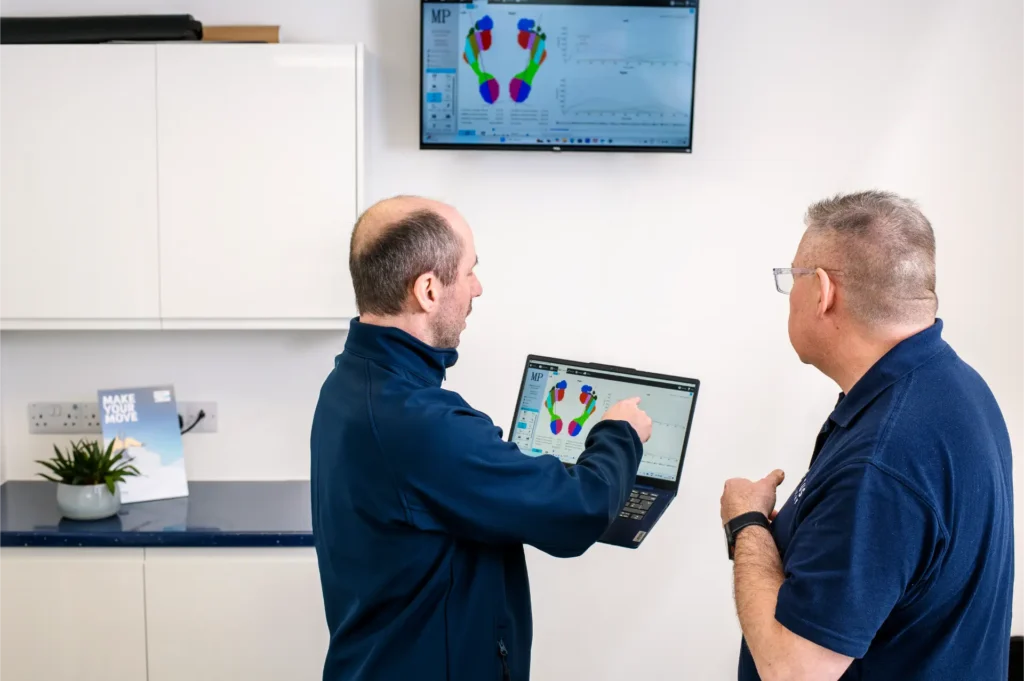
- Integration of objective testing and biomechanical assessment to provide a clearer understanding of how movement, strength and tissue capacity influence injury and injury risk.
- Support for both acute and long-standing lower-limb conditions, helping improve movement efficiency, reduce recurrent injuries and build long-term resilience for sport, exercise and everyday activity.